Mattress materials and labels
Reading Organic Labels: Materials and Certifications in Organic Mattresses
“Organic” can be a meaningful clue about how a mattress was made. It is not, by itself, a complete description of what is inside, how every component was sourced, or whether the bed will suit your body. To understand the claim, look past the headline: identify the materials, check which parts are certified, and read the certification details alongside the mattress’s construction.
Published 3 November 2026
Mattresses are layered objects. A finished bed may combine a cover, quilting, comfort fillings, an inner support system, adhesives, fire-safety materials and a base layer. A label that describes one of those elements does not automatically describe all the others. “Organic cotton cover,” for example, tells you something specific about the textile claim; it does not establish that the foam, springs, adhesives or entire finished mattress are organic.
That distinction matters because organic mattress materials and certifications are often discussed as though they were a single, simple category. In practice, the word can refer to a particular fibre, a component in the finished product, or a certified process with defined requirements. A careful reader asks not only whether a mattress is described as organic, but also: which material, in which layer, certified to which standard, and by whom?
Certification can make those answers easier to verify. It can provide standards for the sourcing and processing of certain materials, and in some cases the handling of products through a supply chain. But a certificate is not a comfort rating. It does not tell you whether a mattress is soft or firm, whether it will relieve pressure for you, or whether it is appropriate for your bed frame and sleep preferences.
Start with the materials, not the headline
Three materials frequently appear in organic mattress discussions: latex, wool and cotton. Each has different properties and may be covered by different certification schemes. A mattress might use one certified material, several certified materials, or a combination of certified and conventional components. The construction list is the place to begin.
Latex: natural origin is not the same as certified organic
Latex used in mattresses is generally made from rubber-tree sap, but the finished material can vary according to how it is processed and what else is included. “Natural latex” describes its source in broad terms; it does not on its own prove that the latex meets an organic standard. Nor does it mean a product is made entirely without processing.
The Global Organic Latex Standard, commonly abbreviated GOLS, is a certification associated with organic latex. Its requirements concern the latex and relevant stages of processing and handling. When a mattress carries a GOLS claim, check whether the claim applies to the latex in the mattress, whether the finished product is certified or only a component is, and whether the manufacturer identifies the certified material clearly. A statement such as “contains GOLS-certified organic latex” is narrower than “the whole mattress is GOLS certified.”
Ask how much of the mattress is latex and where it sits. A latex comfort layer above a separate support core is different from a mattress built around a single latex core. The distinction affects feel, flexibility and the way the mattress responds to pressure; certification alone does not explain those characteristics.
Wool: filling, quilting and fire-safety roles
Wool may be used as a comfort filling, a temperature-buffering layer, or as part of a mattress’s approach to meeting fire-safety requirements. It can also appear in a topper or protector rather than in the mattress itself. The word “wool” identifies a fibre, not its origin, processing history or certification status.
When a manufacturer describes wool as organic, look for the name of the standard and the scope of the claim. Is it the wool filling, a textile covering, or a fully certified article? If a product uses wool in place of another fire-safety material, read the product’s technical information rather than assuming that every mattress with wool has the same construction or regulatory status.
Wool’s practical qualities depend on how much is used, how it is layered and how the mattress is made. Its presence does not guarantee a particular sleeping temperature, and a material certification cannot predict how warm an individual sleeper will feel.
Cotton: covers and textiles with distinct claims
Cotton is commonly found in mattress covers, quilting, protectors and bedding. Organic cotton is a claim about the fibre’s agricultural origin and, depending on the standard, its processing and chain of custody. A certified cotton cover does not make the latex, wool, adhesives or spring unit organic.
Be precise about the component. “Made with organic cotton” may refer to a cover or a portion of the fabric, while “organic cotton cover” identifies a more specific part. Look for details about the percentage of organic fibre and whether the certification applies to the finished textile or to an upstream input. A well-written specification should let you distinguish a certified material from a broader marketing impression.
What GOTS and GOLS can tell you
The Global Organic Textile Standard (GOTS) is a textile standard covering certified organic fibres and defined requirements for processing. Its scope can include environmental and social criteria at relevant stages of textile production. It is commonly encountered on products made with organic cotton or wool. The exact claim depends on the product category, the certified operation and the label used, so it is worth checking the standard’s current requirements and the certificate details rather than relying on the acronym alone.
GOLS focuses on organic latex and its supply chain. It is not interchangeable with GOTS: one relates to latex, the other to textiles. A mattress could use GOLS-certified latex and a GOTS-certified cotton cover, but those claims concern different materials and standards. If both appear in a product description, verify that the manufacturer states which component each one covers.
Certification names are most useful when they are accompanied by verifiable information: the certifying body, certificate or licence details where available, the certified product or facility, and the material covered. A logo without context may leave important questions unanswered. If you cannot tell whether a certificate refers to a raw material, a manufacturing facility or a finished product, ask the manufacturer for clarification.
Standards and certification arrangements can change. For current criteria, use the organisations’ official resources and the product’s own documentation. A retailer’s summary may be helpful, but it is not a substitute for checking what the certification actually covers.
A practical method for reading an organic claim
Rather than trying to decode every badge at once, work through the label in a fixed order. The aim is not to treat a certification as a guarantee of perfection; it is to understand the boundaries of the claim and compare the mattress on terms that matter to you.
- Identify the exact wording. Note whether the product is called “organic,” “made with organic materials,” “natural,” or “contains certified organic latex.” These phrases do not necessarily mean the same thing.
- List the layers. Find a construction description covering the cover, comfort fillings, core or spring system, and any other stated materials. Ask about components that are not described.
- Match each claim to a component. Establish whether the certification refers to cotton, wool, latex, a textile, a facility or the complete mattress.
- Check the certification name and scope. Look up the standard through its official source. Do not assume that two different logos certify the same qualities.
- Ask about percentages when relevant. If only part of a textile or filling is certified, the proportion can help you understand what the product claim means.
- Separate materials from performance. Assess firmness, pressure relief, dimensions, care instructions and compatibility with your base independently of the organic claim.
- Keep the documentation. Save product specifications and certification information in case you need to compare options or follow up with the manufacturer.
This process turns a vague question—“Is it organic?”—into several answerable ones. It also makes comparison fairer: two mattresses may use the same materials but differ substantially in their proportions, construction and certification scope.
What certification does not tell you
A certification is evidence against a defined set of criteria. It is not a universal endorsement of a product, and it should not be treated as proof of every benefit sometimes attached to organic bedding. In particular, certification does not independently establish that a mattress will improve sleep, ease pain, prevent allergies, or be suitable for every household.
Comfort remains personal. Body shape, sleeping position, temperature preference, existing bed base and the age or condition of a mattress all influence how a surface feels. A certified organic latex layer may feel resilient and contouring, but the final result depends on its thickness, density, surrounding layers and overall design. A wool filling can contribute cushioning, yet it cannot tell you whether the mattress is the right firmness.
Certification also does not necessarily mean “chemical-free.” Materials are processed, and finished mattresses must meet applicable safety requirements. Look for specific, substantiated information about emissions or restricted substances if those issues are important to you. Avoid relying on absolute language unless the claim is clearly defined and supported.
Finally, “organic” does not automatically mean that a mattress is more durable, easier to care for, or environmentally preferable in every respect. Longevity depends on design, materials, use and maintenance. A product’s overall environmental impact involves more than the origin of one fibre, including manufacturing, transport, expected lifespan and end-of-life options.
Use construction details to make a real comparison
Once you have checked the claims, read the construction description as a map of the mattress. A clearly described product might specify the type and thickness of a latex core, identify wool or cotton layers, and explain how the cover is made. If the only available description is a list of appealing materials, you may still not know how they are arranged or how much of each is present.
For example, a GOLS-certified latex layer and a GOTS-certified cotton cover would provide information about two distinct components. You would still need to establish whether the mattress contains other foams or materials, how its core supports the body, and what firmness options are offered. The same applies to a mattress that uses certified organic wool: its filling does not by itself describe the mattress’s support system.
A useful product specification should be specific enough to answer basic questions without requiring a reader to infer details. If it does not say whether the certification applies to a component or to the finished item, that is a reasonable question to put to the manufacturer. Clear answers are more useful than a long string of unqualified sustainability terms.
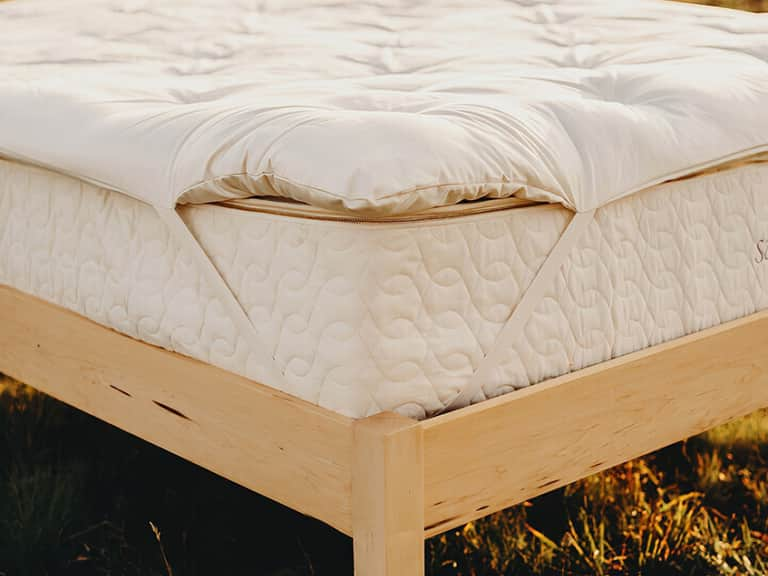
The same distinction applies to bedding accessories. A topper can add a layer of wool or latex to an existing mattress, but it does not change the certification status of the mattress underneath. As one example of a separate accessory, the Savvy Rest Natural Savvy Woolsy Mattress Topper is described as using a certified organic cotton casing and natural wool filling. That information relates to the topper’s stated materials, not to the bed it is placed on.
Questions worth asking before you decide
- Which parts of the mattress are certified organic, and which standard applies to each part?
- Does the certification cover the finished product, a specific material, or a production facility?
- What percentage of the relevant fabric or filling is certified organic?
- What are the complete layers, including the support core and any materials not included in the headline claim?
- Can the manufacturer provide current certification information or identify the certifying organisation?
- What firmness options, dimensions and base requirements are specified?
- How should the mattress be maintained, and which parts can or cannot be washed?
These questions need not turn a mattress purchase into an investigation. Their purpose is to replace assumptions with useful facts. A manufacturer should be able to distinguish a certified component from a broad product description and explain how the mattress is constructed.
A clearer definition of “organic mattress”
There is no shortcut in the label itself. “Organic mattress” may be convenient shorthand, but the meaningful information lies in the materials and the scope of the supporting claims. Read “organic” as an invitation to ask for particulars, not as a complete verdict.
For latex, investigate whether the material is certified and how it is used. For wool and cotton, identify the relevant textile or fibre certification and the component it covers. Then consider the rest of the construction, from comfort layers to support core, and assess whether the mattress’s feel, dimensions and care needs fit your circumstances.
Certification can bring transparency to a complicated supply chain. Used carefully, it helps separate documented standards from broad impressions. But the strongest decision comes from combining that evidence with a plain account of the materials, a clear description of construction and a realistic assessment of comfort. The label is a starting point. The details are the story.
Frequently asked questions
Does an organic cotton cover mean the whole mattress is organic?
No. It describes a claim about the cover or textile, depending on the wording and certification. Other layers may use different materials and may not carry the same certification.
Are natural latex and organic latex the same?
No. “Natural latex” generally describes latex derived from rubber-tree sap. “Organic” is a further claim that should be supported by an identified standard and clear information about the material and its certification scope.
What is the difference between GOTS and GOLS?
They apply to different material categories. GOTS is a textile standard commonly associated with organic fibres such as cotton and wool; GOLS is associated with organic latex. Check the specific product documentation to see which component each certification covers.
Does an organic certification tell me which mattress will feel best?
No. Certification concerns defined material or processing criteria. Firmness, pressure relief and comfort depend on the mattress’s construction and on the person using it.